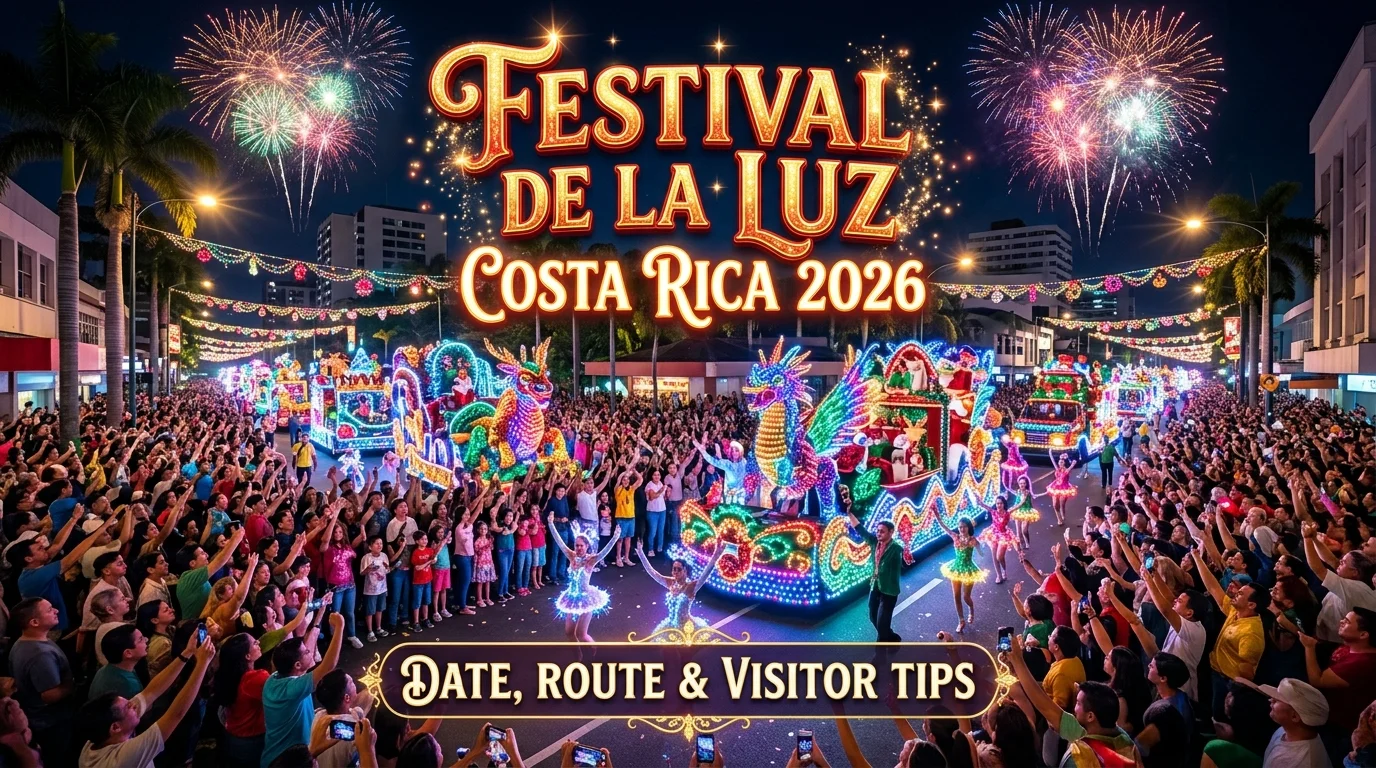
Festival de la Luz Costa Rica is the annual Christmas parade of San José, a night of lit floats, marching bands, and fireworks that officially opens the holiday season. The Municipality of San José has organized it since 1996. It falls on the second Saturday of December, which lands on December 12 in 2026.
The numbers explain why the parade matters. Organizers expected about 12,000 people inside the National Stadium and more than 500,000 in the surrounding park for the 2025 edition, with roughly one million combined in-person and television viewers. Stadium admission was free, and a signature float from the national tourism board has long been part of the lineup. Since 1999, the city has also named a grand marshal, a person or institution honored for bringing pride to the country.
But 2026 is different. The parade moves to a third route in three years, public institutions have pulled out of the float lineup, and organizers plan giant balloons and twelve auditioned marching bands. Details still shift, so read this guide as a snapshot.
Below you’ll find the 2026 date and route, the festival’s history, how the parade works, a sample schedule, safety and transportation tips, and how to pair the night with tours around La Fortuna and Arenal Volcano.
The Festival de la Luz Costa Rica 2026 parade runs on Saturday, December 12, and city councilors have confirmed a route that starts at Plaza de la Democracia, beside the National Museum, and ends at Torre Mercedes on Paseo Colón. Route changes have become a pattern. The 2025 festival used a closed circuit around La Sabana Metropolitan Park, and earlier editions followed Paseo Colón and Avenida Segunda.
The float lineup has shrunk. Banco de Costa Rica, Banco Nacional, Banco Popular, Grupo INS, and Kölbi announced they would not take part, each citing budget, marketing, or scheduling reasons. The city says it is negotiating with private companies, so the final list may change before December.
Organizers are adding new attractions instead:
– Giant balloons: The city set aside about 31 million colones (roughly $68,000), though the number and designs are not public.
– Marching bands: Twelve bands were chosen at auditions in late September, including municipal groups from Alajuela, Tibás, and Sarchí, plus a band from La Fortuna.
– Fireworks and lights: Recent editions have used drone shows, and organizers have not confirmed the 2026 finale.
Start time, road closures, and viewing zones had not been published at the time of writing. Because those details decide where you sleep and how you travel, check the municipality’s channels about a week before your trip. Understanding how the festival began helps explain why it keeps evolving.
San José’s city hall launched the first parade of floats and bands in 1996. Early editions drew a handful of floats, with entries from companies, banks, and amusement parks. Over the years the festival grew into a national event covered by regional broadcasters.
The marshal tradition began in 1999 with astronaut Franklin Chang Díaz. Later marshals included Olympic swimmer Claudia Poll and cyclist Andrey Amador. Judges score floats on categories such as most shining, most original, and best light effects, and bands compete for awards for execution, choreography, and school or community representation.
The parade has already outlasted several formats, including a pandemic cancellation. Its core idea stays the same: light, music, and a public party in the capital. Here is what that looks like on parade day.
The Festival de la Luz Costa Rica parade mixes three elements. Lit floats carry brand or institutional themes, with bulbs, moving parts, and costumed performers. Marching bands play holiday and popular tunes while walking the route. Street performers, stilt walkers, and masked dancers fill the gaps.
Judges pick winners among floats and bands, and the grand marshal leads the procession. Kölbi, the mobile brand of the state utility ICE, took the float prize in 2025, and the band from Colegio Don Bosco won the band category. In 2026, with fewer floats expected, the bands and balloons will carry most of the visual load.
The event is a free public celebration. Families bring chairs, kids, and snacks, and vendors sell food along the route. Locals arrive hours early to claim sidewalk space. A sample timeline shows how the day usually unfolds.
The 2025 edition offers the best template, since the 2026 schedule is not yet public. On Saturday, December 13, 2025, the lineup ran like this:
| Time | Event |
| 8:00 AM | Band Fest at the National Stadium |
| 10:00 AM | Christmas market in La Sabana Park |
| 1:00 PM | Masquerade parade |
| 6:00 PM | Main event, floats and bands |
| 7:30 PM | Drone show and fireworks finale |
The market held about 150 booths with local entrepreneurs and food trucks, and television stations broadcast the main parade live. Road closures began on Thursday night and lasted until Sunday morning. Expect similar patterns in 2026, though the new route will change which streets close.
The stretch between 1:00 PM and 6:00 PM is the best time to walk the route, scout viewing spots, and eat. Getting around San José that afternoon takes planning.
The best viewing spots are along Paseo Colón, near Torre Mercedes, and around Plaza de la Democracia. Sidewalks fill by late afternoon, and parts of the route may close to pedestrians as well. Arrive by 3:00 PM if you want a front-row view.
Driving downtown on parade day is a poor idea. Roads close, parking disappears, and detours slow traffic to a crawl. Better options include:
– Walking from a hotel in Barrio Amón, Paseo Colón, or Sabana.
– Taking a licensed red taxi or a ride-hailing app, and agreeing on the drop-off point before you leave.
– Booking a driver for the return trip, since taxis are scarce after the fireworks.
Travelers who base themselves in La Fortuna should plan an overnight in the capital instead of a same-day round trip. The drive takes about three hours in normal traffic, and the return after midnight is tiring. A private transfer from San José removes the stress of parade traffic and bus schedules, and it works well for groups with luggage. Safety deserves a few lines too.
Large crowds attract pickpockets, so carry minimal cash and keep your phone in a front pocket or inside bag. Pick a meeting point with your group in case you get separated. The U.S. State Department rates Costa Rica at Level 2 (Exercise Increased Caution), which reflects petty crime in busy places.
Costa Rica does not observe daylight saving time, so San José runs one hour behind New York in December. Sunset falls around 5:30 PM, which means the parade starts in darkness. Wear comfortable shoes and bring a light jacket, since evenings feel cooler than days.
Be careful with ticket sellers. Entry to the street parade is free, and no official seller of seats had been announced when this was written. The stadium typically offers free admission as well. Where you sleep affects how easy the night feels.
Street food is half the fun. Vendors along the route sell grilled corn, empanadas, churros, and fruit cups, and Christmas markets in recent years have added food trucks and local craft booths. The 2025 market alone listed about 150 booths with products from small Costa Rican businesses, from coffee and chocolate to handmade ornaments.
Holiday season also brings seasonal treats. Tamales, rompope (a rum-based eggnog), and sweet fruit breads show up in homes and stalls across the country in December. Paying in small colones bills speeds up lines, and vendors rarely take cards. Parents often ask whether the evening works for children.
Families attend in large numbers, and kids tend to love the lights, balloons, and drums. The main challenge is the crowd and the late hour. The big parade starts around dusk and the finale can run past 8:00 PM, which is a long day for toddlers.
A few habits make the night easier:
– Claim a spot near a corner, where it’s simpler to step out of the crowd.
– Bring a folding stool, water, and a light snack.
– Set a meeting point and write your hotel’s phone number on a card.
– Plan a short walk back to the hotel instead of a long drive.
Travelers with limited mobility should watch from a hotel balcony or a restaurant window along Paseo Colón, and ask in advance whether the venue reserves tables for parade night. Rain can interrupt the evening, so a poncho is worth the space in your bag. Those small details matter more once you decide where to sleep.
Hotels near Paseo Colón, La Sabana, and the city center fill first, and prices climb in the weeks before the festival. Book at least six weeks ahead if you want a room within walking distance of the route. Barrio Amón and Barrio Escalante have boutique hotels and good restaurants, and they sit a short ride from the parade.
Early December sits at the front edge of peak season. Flights and rental cars get pricier after mid-month, and the cheapest window usually falls in the first week. The best time to visit Costa Rica guide shows how December compares with other months. If you want the festival plus a longer holiday, build the itinerary around the capital first and the volcano second.
Most visitors treat the festival as a one-night stop, then head north for rainforest and volcano scenery. La Fortuna sits roughly three hours from the capital, and Arenal Volcano dominates the horizon. Early December can still bring afternoon showers there, but mornings are often clear.
Local operators offer a wide range of tours around La Fortuna and Arenal, including hanging bridges, waterfall hikes, and guided wildlife walks. The sloth watching tour costs $61 per person, and the hanging bridges tour costs about $74. Both slot easily into a day after the capital.
Travelers who want hotels, transfers, and activities arranged in one plan can compare Costa Rica vacation packages that combine regions. For the wider calendar of parades, ceremonies, and holidays across the month, see this guide to Costa Rica festivals in December.
Festival de la Luz Costa Rica opens the holiday season on Saturday, December 12, 2026, with a night parade of bands, giant balloons, and possibly a smaller group of floats along a new route from Plaza de la Democracia to Torre Mercedes. The city has organized the festival since 1996, and it keeps changing format while holding onto light, music, and free public access.
Check the route and schedule a week before you travel, arrive early, avoid driving downtown, and keep valuables close. Then use the days that follow to explore La Fortuna and Arenal Volcano. A bit of planning turns one night in the capital into the start of a good December trip.
Festival de la Luz takes place on Saturday, December 12, 2026, in San José. The municipality has not yet published the start time or final schedule, so confirm details a week before you travel.
Yes, watching the street parade is free. The 2025 stadium events also offered free admission, and no official seat sales had been announced for 2026. Treat anyone selling tickets as unofficial.
The 2026 route starts at Plaza de la Democracia and ends at Torre Mercedes on Paseo Colón. It is the third route in three years, after the 2025 circuit around La Sabana Park and the older Paseo Colón and Avenida Segunda route.
Fewer floats are expected. Five public institutions, including Banco Nacional, Banco de Costa Rica, Banco Popular, Grupo INS, and Kölbi, said they would not take part. Organizers plan giant balloons and twelve marching bands, and private companies may still enter floats.
Yes, if you enjoy parades, live music, and big public celebrations. The event draws hundreds of thousands of people, so it suits travelers comfortable with crowds. Visitors who prefer quiet should spend the evening in La Fortuna instead.

With a passion for tropical wildlife and sustainable tourism, Emily brings the magic of Costa Rica directly to her readers. She spends her time exploring the hidden waterfalls, cloud forests, and diverse ecosystems surrounding La Fortuna. Emily’s mission is to share insider travel tips that help guests connect authentically with local culture and nature.
 Festival de la Luz Costa Rica 2026: Date, Route and Visitor Tips
 Costa Rica Festivals in December: Dates, Events and Travel Tips
 Rio Celeste Waterfall Costa Rica: Trail, Tickets and Tour Guide for 2026
 Top Reasons to Travel with the Best Costa Rica Tour Company
 Costa Rica Pacific Ocean Temperatures: How Warm Is the Water Month by Month
